anyone know anyone else who carries pdo? (PDO - 1,3 Propanediol)
diy-ejuice.com is oos and i cant find anyone else selling it..
These guys seem to have it. I believe DOW makes it, and they don't want it used for ejuice (presumably because they don't want the FDA to class it a tobacco product and/or they're worried about long-term liability issues) so mostly they only want to sell it to cosmetics producers and such.
So is PDO a PG replacement?
hydavape out of Arnprior On. carries some. I've never bought from them before though.
> (PDO - 1,3 Propanediol)
Could someone ELIOASICC^^1 what it means when a compound is described as "x,y <name>"?
^^^1 ^(Like I'm Old And Sucked in Chemistry Class)
Sure, so the molecule has a carbon backbone as noted by the "propane" description. Methane, ethane, propane, butane, pentane, etc. describe the carbon # from 1 to 5 carbons in the sequence listed. So "propane", for PDO meaning 3 carbons. Next, the suffix "diol" is two things combined together, first "di-" for two (mono, di, tri, tetra, etc. meaning 1, 2, 3, or 4 of something). Second is "-ol" denoting an alcohOL. The numbers "1,3" tell you on what carbon(s) the functional groups (a chemically reactive atom group attached to a carbon) are located. So, adding everything up we have 1,3-propanediol, a molecule with 3 carbons in a row and 2 alcohol functional groups, one attached to the first carbon, one attached to the third. Looks like this.
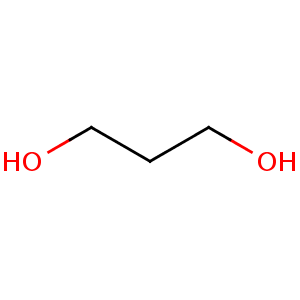
To elaborate further, "a" in propAne, also tells you there only single carbon-carbon bonds in the molecule. If there were higher "bond order" bonds in there we would see something like propEne for a double bond, and propYne if there was a triple bond. It's accepted that carbon likes to have 4 bonds at all times, as a mixture of single, double, and triple bonds, repectively, and the structure I showed is whats known as a skeleton structure. This means that any bond that isn't shown is implied to be a hydrogen bond. Therefore, the chemical structure of 1,3-propanediol (propane-1,3-diol also) can be written as (HO)CHCH2CH(OH).
As close as I can remember, various chemical compunds can have more than one possible structure while retaining the same number and type of atoms. Generally the way you synthesize the compound will determine which structure is formed. So the numbers tell people who weren't too stoned in Chem class (unlike us) what the structure is. Assuming I remembered that right, and it wasn't just something I hallucinated back then.